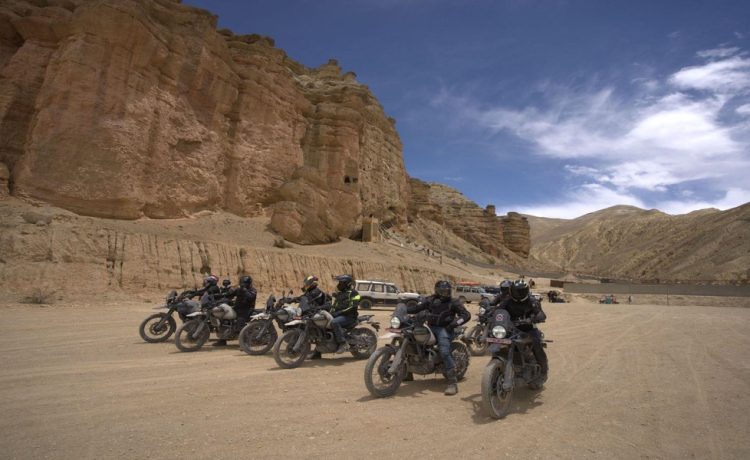
The first time the road dissolved into loose scree somewhere above 4,800 metres on the Spiti Valley circuit, my hands were steady. My bike was upright. My gear was perfectly sorted. But my mind was not. It was running catastrophe scenarios at altitude speed, low oxygen, high consequences, and I was frozen in a way no amount of physical training had prepared me for.
Every Himalayan motorcycle expedition guide online tells you what to pack, what to eat at altitude, how to acclimatise, and which passes are hardest. Precious few tell you what to do when your mind turns against you at 5,000 metres with no signal and forty kilometres of broken road ahead. That gap between physical readiness and genuine mental preparation for a Himalayan motorcycle trip is what this article addresses.
Below are the four psychological pillars that experienced expedition riders quietly build before they ever load the panniers. Master them, and the mountains become a challenge you navigate. Ignore them, and they become a crisis you survive.
Why Mental Preparation Is the Missing Piece of Himalayan Riding
Search for any Himalayan motorcycle expedition checklist and you will find detailed packing lists, service schedules, tyre pressure guides, and altitude sickness protocols. Mental preparation gets, at best, a single line: “be mentally strong.” It is the most inadequate piece of advice in adventure travel.
What Altitude Actually Does to Your Decision-Making
This is not a metaphor. At elevations above 3,500 metres, the brain operates under genuine physiological stress. Research in wilderness medicine consistently shows that hypoxia – reduces oxygen to the brain, measurably impairs executive function, slows reaction time, increases risk tolerance, and reduces the ability to accurately assess danger. These are precisely the cognitive skills a motorcyclist needs most on a boulder-strewn descent above a cliff face.
HACE (High Altitude Cerebral Edema) and HAPE (High Altitude Pulmonary Edema) represent the severe end of this spectrum, but riders rarely talk about the subtler cognitive fog that precedes them. That fog is where bad decisions live: pushing past a safe stopping point because you feel fine, ignoring a developing mechanical issue, misjudging a road surface. A mind that has never been stress-tested does not perform well under these conditions.
“Physical fitness gets you to the pass. Mental fitness decides what happens when everything goes wrong at the top of it.”
The Physical Checklist Nobody Pairs with a Mental One
Before any serious expedition, most riders confirm: first aid kit, recovery tools, spare parts, navigation devices, emergency contacts, permits. Almost nobody creates an equivalent mental preparation checklist. The pillars below give you the components for one.
Pillar 1: Managing Uncertainty and Route Unpredictability
The Himalayan riding environment is definitionally unpredictable. Roads passable last week may be blocked by a landslide today. Rohtang Pass closes on no set schedule. Zoji La can be black ice in August. Baralacha La holds snowdrifts that appear from nowhere. A rider who has not mentally rehearsed operating under uncertainty will either take dangerous risks to stick to a plan, or freeze entirely when the plan breaks.
The Pre-Mortem Technique: Visualise Failure Before You Ride
Popularised in decision science by Gary Klein, the pre-mortem is a structured exercise: before the expedition, imagine it has failed catastrophically. Write down every plausible cause – weather, mechanical breakdown, injury, exhaustion, a wrong turn. Then write a specific response for each. This is not pessimism. It is the cognitive equivalent of an emergency drill. When the scenario occurs in reality, your mind does not generate a response from scratch. It retrieves one.
Before your Himalayan motorcycle expedition, spend 45 minutes writing your pre-mortem. The act of imagining failure in detail is what inoculates you against panic when partial failure actually arrives.
When to Turn Back: The Hardest Mental Skill of All
Most riders who get into serious trouble on Himalayan expeditions did not lack skills. They lacked a pre-committed framework for when to abandon a plan. The ego, the excitement, the sunk-cost of months of preparation – all of these push riders forward past the point of wisdom.
Before you leave, write three non-negotiable turn-back criteria. For example: if locals assess the road ahead as impassable that day; if a riding partner shows grade 2 altitude sickness symptoms; if you reach a high pass after 2 p.m. with a visible storm. These criteria must be set in advance, in writing, when your judgment is unimpaired by altitude and adrenaline.
Pillar 2: Solitude, Isolation, and the Long Stretches with No Signal
The Hanle plateau in Ladakh. The road between Kaza and Losar in Spiti. The high-altitude stretch of the Manali-Leh Highway before Pang. These are among the most beautiful places a motorcycle can take you – and also among the most psychologically demanding, because they are vast, empty, and completely silent.
Riders who have spent their lives in urban environments surrounded by constant stimulation often find the psychological weight of real isolation far heavier than expected. The absence of a signal is not merely an inconvenience. For many riders it triggers a low-level anxiety that compounds with physical fatigue into something that genuinely impairs riding.
The Difference Between Solitude and Loneliness at 15,000 Feet
Solitude is chosen stillness with a settled mind. Loneliness is the feeling of disconnection that corrodes from within. The Himalayas offer both, sometimes within the same hour. Riders who have practised sitting with their own thoughts – through meditation, long solo rides without music, or structured alone time – report dramatically better psychological endurance on remote stretches than those who have not.
Practising Digital Detox Simulation Before You Leave
The preparation is straightforward and uncomfortable: in the six weeks before departure, take one full day per week without a smartphone. No music, no podcasts, no messages, no maps. Do your errands, cook a meal, sit in silence. The first time is genuinely hard. By the fourth time, you have built the mental muscle for extended disconnection. The Himalayan road will feel familiar rather than foreign.
Pillar 3: Managing Fear, Ego, and Peer Pressure on Technical Terrain
Group motorcycle tours to Khardung La and Umling La are increasingly popular, and they introduce a psychological hazard that solo riders largely avoid: peer pressure. When a group moves at a pace faster than your comfort level, the social instinct to keep up overrides the rational instinct to ride within your skill set. Accidents on Himalayan group tours disproportionately involve riders who were pushing slightly beyond themselves to match the pace around them.
Fear Is Data, Not Weakness: Reframing Your Body’s Warning System
When your hands tighten on the bars approaching a scree-covered descent and your stomach drops, that is not weakness. That is your nervous system collecting data about road conditions, your current skill level, and the consequences of an error. The riders who get into the worst trouble are often those who have trained themselves to ignore that signal entirely, mistaking fear for weakness and suppression for courage.
The correct relationship with fear on technical Himalayan terrain is: acknowledge it, read it for its specific information, then decide deliberately. Fear says something is wrong here. Your job is to diagnose what, and respond proportionally.
The Ego Audit: 5 Questions Every Rider Must Answer Honestly
Answer these in writing, alone, at least two weeks before your expedition. Share your answers with one trusted person who will tell you the truth:
- What is my honest assessment of my technical skill level on unpaved mountain roads – not my optimistic assessment?
- Am I going on this expedition because I genuinely want to, or partly to prove something to someone?
- If the group I ride with moves faster than I am comfortable with, do I have a concrete plan for addressing that – or will I just keep up?
- Have I ridden in cold, wet, or high-wind conditions for multiple consecutive days? How did I actually respond?
- What does “success” mean to me on this expedition – and is that definition flexible enough to include a partial route?
These are not comfortable questions. They are, however, the questions that distinguish riders who return with their stories from riders who become other people’s stories.
Pillar 4: Emotional Endurance: Days 3-7 Are When It Gets Hard
Marathon runners call it the wall. Long-distance cyclists call it the bonk. Himalayan expedition riders call it day four and almost every experienced long-distance rider knows exactly what it feels like. The initial adrenaline of departure has faded. The body is fatigued and the mind is simultaneously overstimulated by the landscape and exhausted by constant vigilance. I’ve seen riders breaking down in my last motorcycle tour to Nepal. Small frustrations feel enormous. The appeal of turning back becomes briefly, genuinely compelling.
The Expedition Wall: Why Day 4 Tests Riders More Than Any Pass
The Manali-Leh Highway and Spiti Circuit share this in common: around day three or four, cumulative physical and psychological fatigue converges. You are sleeping in basic accommodation, eating simple food, managing a bike that has taken punishment, and navigating unfamiliar roads without rest. The romance of the expedition collides hard with the reality of it.
This is normal. It is not a sign you have made a mistake. It is a predictable phase – and knowing it is coming, naming it in advance, is itself a powerful tool. Riders who expect the wall are far more likely to ride through it.
Micro-Recovery: Mental Reset Techniques That Take Under 10 Minutes
When emotional fatigue accumulates on the road, these four techniques work reliably:
- Stop and make tea. The ritual of stopping, boiling water, and sitting for ten minutes is disproportionately restorative.
- Write three specific good things about the day. Specificity matters – not “the scenery” but “the moment the road curved and Baralacha La came into view.”
- Spend five minutes doing nothing. No phone, no planning. Just observe the landscape in front of you.
- Change your physical position. Stretch, walk 200 metres, adjust your riding posture. A physical reset reliably triggers a cognitive one.
How to Build Mental Resilience Before You Leave Home
Mental resilience for adventure motorcycling is not a personality trait. It is a trainable capacity – and like physical fitness, it responds to progressive overload. The table below operationalises the four pillars into an eight-week pre-departure practice built on stress inoculation: deliberately exposing yourself to manageable discomfort so that unmanageable discomfort loses its power to paralyse you.
Discomfort Training: Why Cold Showers Are Actually Useful
Cold exposure is not a wellness trend in this context. It is a repeatable, low-cost method for training your nervous system to remain calm while your body signals alarm. Two minutes of cold water every morning, sustained over eight weeks, teaches your mind the precise skill it needs at 5,000 metres: to observe physiological stress without being controlled by it. The cold shower is the classroom. The Himalayan pass is the exam.
The Rider Who Arrives Ready in Their Head Always Finishes
Of all the riders who do not complete a Himalayan motorcycle expedition, only a fraction are stopped by mechanical failure. The majority are stopped by mental capitulation – a decision made in a moment of fear, fatigue, or overwhelm that the mind was simply not prepared to handle.
The four pillars of Himalayan motorcycle expedition mental preparation are not complicated, but they require intentionality that most pre-departure planning never reaches:
- Uncertainty management – pre-mortem your expedition and commit your turn-back criteria in advance.
- Isolation tolerance – simulates disconnection before you are forced to live it.
- Fear and ego audit – interrogate your motivations and build a practice of reading fear as data.
- Emotional endurance – expect the wall around day four and equip yourself with micro-recovery tools.
The Himalayas will test all of it. They are extraordinary precisely because they demand everything. Arrive with your mind prepared, and they will give you back more than you brought.